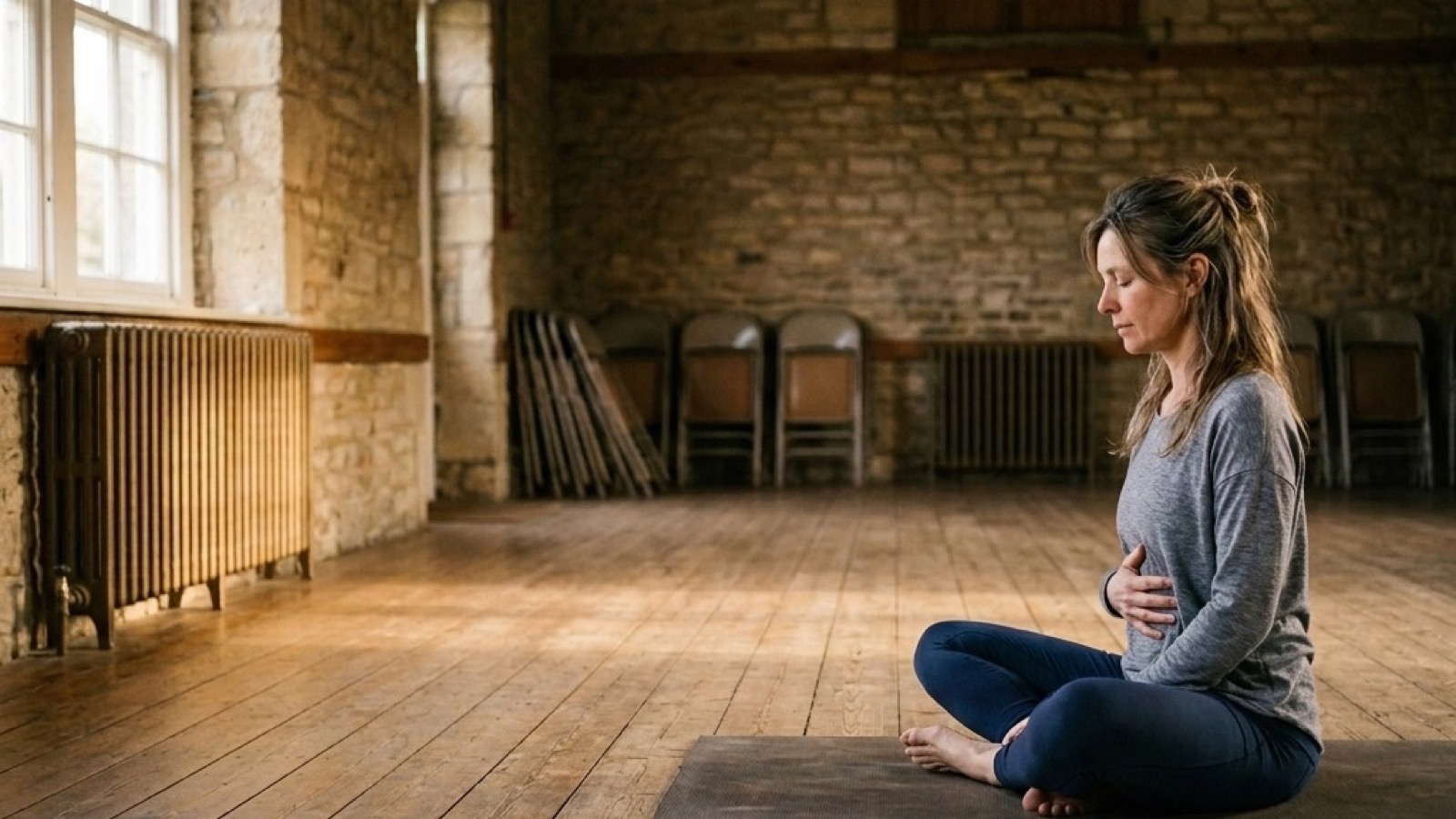
- The classical instruction points one way: make the breath smaller and quieter over months, rather than bigger and faster inside a single class.
- The physiology agrees. Slow, quiet nose breathing nudges carbon dioxide slightly up, which opens blood vessels in the brain and quietens arousal.
- Fast breathing does the opposite. It blows off carbon dioxide, constricts blood vessels, and through the Bohr effect makes haemoglobin hold on to oxygen more tightly.
- On breath retention the honest position is that reliable physiological data is not available, so a general class is not the place to push it.
- What carries most of the benefit is unglamorous: nose breathing, a longer exhale than inhale, kept quiet, in short doses every week.
Teach the quiet end first. Slow, soft nose breathing with the exhale longer than the inhale, taught in short doses and built up over weeks. Not fast breathing in a room you don’t know, and not group breath retention in a drop-in class. The classical instruction and the physiology point the same way, and on retention the honest position is that the evidence isn’t there.
By YogaPros — the professional body for yoga teachers since 2006, with more than 10,000 members across 100+ countries.
Why does this need saying?
Most trainings give pranayama a weekend. Then you teach it for the next twenty years.
So we teach what we remember, in the order it was taught to us, and nobody ever checks. That would matter less if the techniques were harmless. But fast breathing and holding the breath get taught more confidently than almost anything else in a general class, and they’re the two the old instruction was most careful about.
Brian Cooper, who co-founded YogaPros, learned pranayama in an ashram in Haridwar in the 1970s and wrote it up for Amrita Yoga Magazine in 2016. It’s worth going through properly. It describes a way of teaching breath that’s more or less gone, and it doesn’t skate over the physiology.
What did the old teaching actually look like?
The first lesson was a demonstration. Cooper’s teacher blocked one nostril and inhaled, and the breath was completely silent and went on a very long time. Then jalandhara bandha, the throat lock, held considerably longer. Then the lock released and the exhale, also completely silent. One round took more than five minutes.
After that, the training was about making the breath smaller. Yogis measured how far the breath travelled from the nostrils by holding a fine thread of cotton in front of the nose and watching for the point where it stopped moving. Cooper’s teacher used a licked palm held close to the nose, because you can feel the cool of the breath on wet skin. It took months before that palm could touch the tip of the nose without picking anything up.
The aim was for the breath to stay inside the nostrils. Imperceptible. Which is the opposite of where most modern breathwork goes.
The Hatha Yoga Pradipika puts the warning plainly:
“Just as lions, elephants and tigers are controlled by and by, so the breath is controlled by slow degrees, otherwise it kills the practitioner himself”
Plenty of us can quote that line. It isn’t usually the line the class gets built on.
Why does slow, quiet breathing do anything?
The short answer is carbon dioxide.
CO2 isn’t only a waste product. It regulates the pH of blood and of the fluid inside and around every cell, and the body holds that inside tight limits. Blood sits slightly alkaline at pH 7.4. The inside of a cell sits slightly acid at about 6.9.
It also opens blood vessels. In controlled studies where people breathe air containing 5 to 7 per cent carbon dioxide, blood flow to the brain rises by an average of around 75 per cent. Breathing high-oxygen air does the reverse: cerebral blood flow drops by about 13 per cent, and the brain’s oxygen consumption doesn’t change at all.
Raised carbon dioxide also quietens the brain’s electrical activity. The EEG pattern starts to look like the low-arousal states, the drowsy end rather than the thinking end.
Worth being precise about those numbers, because sooner or later a student asks. They come from research with controlled gas mixtures, not from people doing breathing exercises in a village hall. Quiet diaphragmatic breathing shifts the balance mildly in the same direction, and that’s the claim that holds up.
You know the feeling anyway. Settled, and oddly more alert at the same time.
What happens when a class breathes fast?
The opposite, and it’s worth knowing properly.
Fast breathing doesn’t load you with oxygen. Blood is already close to fully saturated, so there’s nowhere for the extra to go. What it does is blow off carbon dioxide, and everything follows the wrong way from there. Blood vessels constrict. Blood flow to the brain falls, taking oxygen and glucose down with it. Smooth muscle constricts elsewhere too, in the airways and in the gut, which is why over-breathing can make asthma and irritable bowel worse rather than better.
There’s one more turn in it. Under the Bohr effect, as carbon dioxide falls, haemoglobin holds on to oxygen more tightly. So the blood can be carrying plenty of oxygen while the cells receive less of it.
That’s the room that’s been breathing hard for two minutes and feels peculiar. Light-headedness, tingling hands, occasionally somebody on the floor. Nothing is being released. Carbon dioxide is low.
Is it safe to teach breath retention?
The honest answer is less confident than the way it usually gets taught.
Cooper sets out the texts and the physiology and then declines to settle it. Whether the classical kevala kumbhaka means genuine breath retention or breathing so refined it can’t be detected is left open, because the texts don’t resolve it and reliable physiological data on the effects of breath retention is not available.
What is known is the limit. Very high carbon dioxide has an anaesthetic effect. Push far enough and it depresses the respiratory control centres, and consciousness goes. That limit is physiological. It doesn’t move because a student is experienced.
So the working position for a general class:
- Teach retention individually, if at all, and not as a group exercise in a room where you don’t know everybody.
- Never teach breath-holding in or near water. Rapid breathing followed by a breath hold is how people drown.
- Leave it out where a student is pregnant, or has uncontrolled high blood pressure, a heart condition, glaucoma, epilepsy or a history of panic attacks. If you’re unsure, leave it out and say plainly why.
- Progress it across months. Not inside a class, and not to impress a room.
None of that is timid. It’s what the texts have always said, in modern language.
So what do you teach on Tuesday?
The techniques that carry most of the benefit are the unglamorous ones, and they were always the ones taught first.
- Nose breathing, always. The nose provides resistance, and resistance alone shifts the balance slightly towards carbon dioxide. That’s most of the effect you’re after.
- A longer exhale than the inhale. No counting theatre required at the start. Longer out than in, soft, for two or three minutes.
- Quieter, not bigger. Told to breathe deeply, most students breathe hard. Ask for quieter and smaller and you get the thing the tradition was pointing at.
- Ujjayi as resistance, not as a sound effect. The value is the mild resistance it creates. If you can hear it from the back of the room, it’s gone past the point.
- Alternate nostril, taught slowly and without retention. It adds resistance and slows the breath down. Both of those are worth having on their own.
- Short doses, often. Two or three minutes at the beginning or the end, most weeks, will do more than one long session a term.
The Buteyko method, used to manage asthma, is nose breathing kept very quiet, using the diaphragm rather than the chest. Which is a fair description of what a yoga class has always taught, when it teaches breath properly.
Cooper’s account ends without answering the big question, and leaving it open is the honest thing to do. The practical part isn’t really in doubt though. Teach the quiet end, build it slowly, and when a student asks whether they should be holding for longer, the accurate answer is that we don’t have the evidence for that, so we go gradually.
Adapted with permission from “To Breath Or Not To Breathe, That Is The Question” by Brian Cooper, first published in Amrita Yoga Magazine, issue 2, 2016.